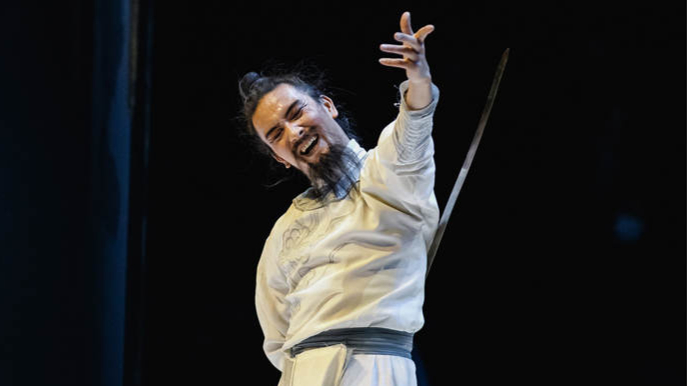
Poet Li Bai
Introduction
Li Bai (701-762), also known as Li Po, is one of the most acclaimed poets in Chinese history. Revered for his imaginative style and romantic flair, Li Bai's work captures the beauty and spontaneity of the natural world, and he is often referred to as the "Immortal Poet." Born during the Tang Dynasty(618-907), a period celebrated for its flourishing cultural and artistic achievements, Li Bai's poetry reflects the grandeur and vitality of this era. His verses have not only left an indelible mark on Chinese literature but have also inspired countless generations, making him a profound symbol and a wellspring of spiritual nourishment for the Chinese people.
Life and Career
Li Bai's life was characterized by a series of wanderings and adventures, which greatly influenced his poetic output. Born in what is now present-day Sichuan province, Li Bai displayed a remarkable talent for poetry and literature from an early age. His early life was marked by extensive travel across China, during which he encountered diverse landscapes and cultures that would later serve as inspiration for his poetry.
Despite his literary talent, Li Bai's career in the civil service was fraught with difficulty. His outspoken nature and disdain for the rigid structure of officialdom often put him at odds with the imperial court. Nonetheless, his interactions with fellow poets and scholars, including his famous contemporaries Du Fu and Wang Wei, enriched his literary circle and contributed to the development of his unique style.
Literary Style and Contributions
Li Bai's poetry is renowned for its emotional depth, lyrical beauty, and imaginative scope. He frequently drew upon themes of nature, friendship, love, and the transient nature of human life. His ability to weave vivid imagery with profound philosophical insights earned him a lasting place in the canon of Chinese literature.
One of Li Bai's signature works, Drinking Alone under the Moon, exemplifies his characteristic merging of personal reflection and natural imagery. His Thoughts on a Tranquil Night remains one of the most widely memorized and cherished poems in Chinese culture, celebrated for its simplicity and evocative power.
Influence and Legacy
Li Bai's influence extends far beyond his lifetime, resonating through the centuries as a source of artistic inspiration. His works have been adapted into various forms, including dance dramas and modern media, demonstrating the enduring appeal of his poetry.
The China National Opera & Dance Drama Theater has produced dance dramas that depict Li Bai's life, capturing his internal struggles and artistic triumphs. Through these performances, audiences gain insight into his passion, talent, and the complexities of his character.
Moreover, Li Bai's poetry continues to inspire contemporary artists, musicians, and filmmakers, both within China and internationally. His verses have been featured in exhibitions and cultural events, further solidifying his status as a cultural icon.
Cultural Exhibitions and Modern Interpretations
Recent exhibitions at prominent venues like the China Millennium Monument in Beijing have showcased Li Bai's work through innovative mediums such as new media art, paper-cut spaces, and immersive experiences. These exhibitions invite visitors to step into the spiritual world and legendary life of the Poet Immortal, underscoring his lasting impact on Chinese cultural heritage.
Li Bai's poetry has also found a place in modern music and cinema. For instance, the movie Chang‘an, which explores the life and times of Li Bai, has gained popularity in China, highlighting the poet's universal themes and the distinct approach of Chinese culture to poetry.








